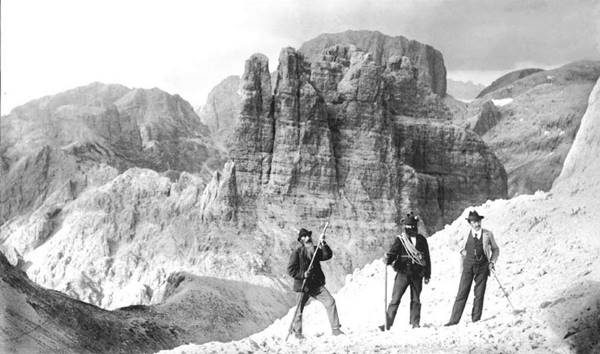
Within a summer, four groups of English and German “lords” arrived in Molveno with the aim of crossing the Brenta Dolomites. From that date more and more climbers: English, Germans and Italians began to explore the mountains around Molveno. In 1865 John Ball reached as second Cima Tosa. During these years mountaineers such as Freshfield, Tuckett, Ball and many others arrived.
THE FIRE OF 1921
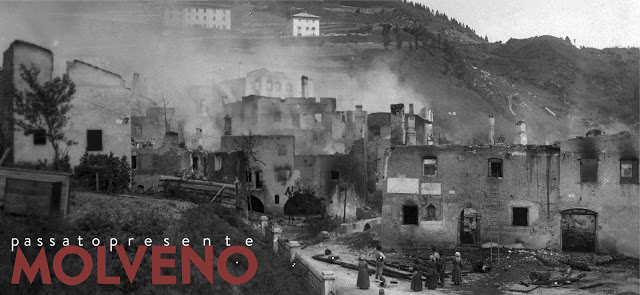
The fire in Molveno began around 3 pm on Monday 5 September, destroyed and transformed the town of Molveno for the second time after the 1791 blaze. The journalist who went there on 6 September wrote: The fire developed so quickly that the person who first noticed it, while preparing to leave the porch to raise the alarm, was almost overwhelmed by flames. Molveno was a mass of grouped houses, piled one upon the other, with narrow streets so that the roofs of the houses at certain points touched each other. In less than half an hour all the roofs of the central houses blazed with flames, collapsing with a sinister roar and raising clouds of dense fumes and trails of sparks which in turn carried the fire further and further away. The number of the destroyed houses was about sixty, over 100 families out of 150 lost their roofs, furnishings and, what is worse, all the forages piled up with much effort in the barns were lost. The calculation of the damages was estimated at 3 million lire and the insurances did not give more than 200 thousand lire.
THE BELLE EPOQUE OF TOURISM IN MOLVENO:
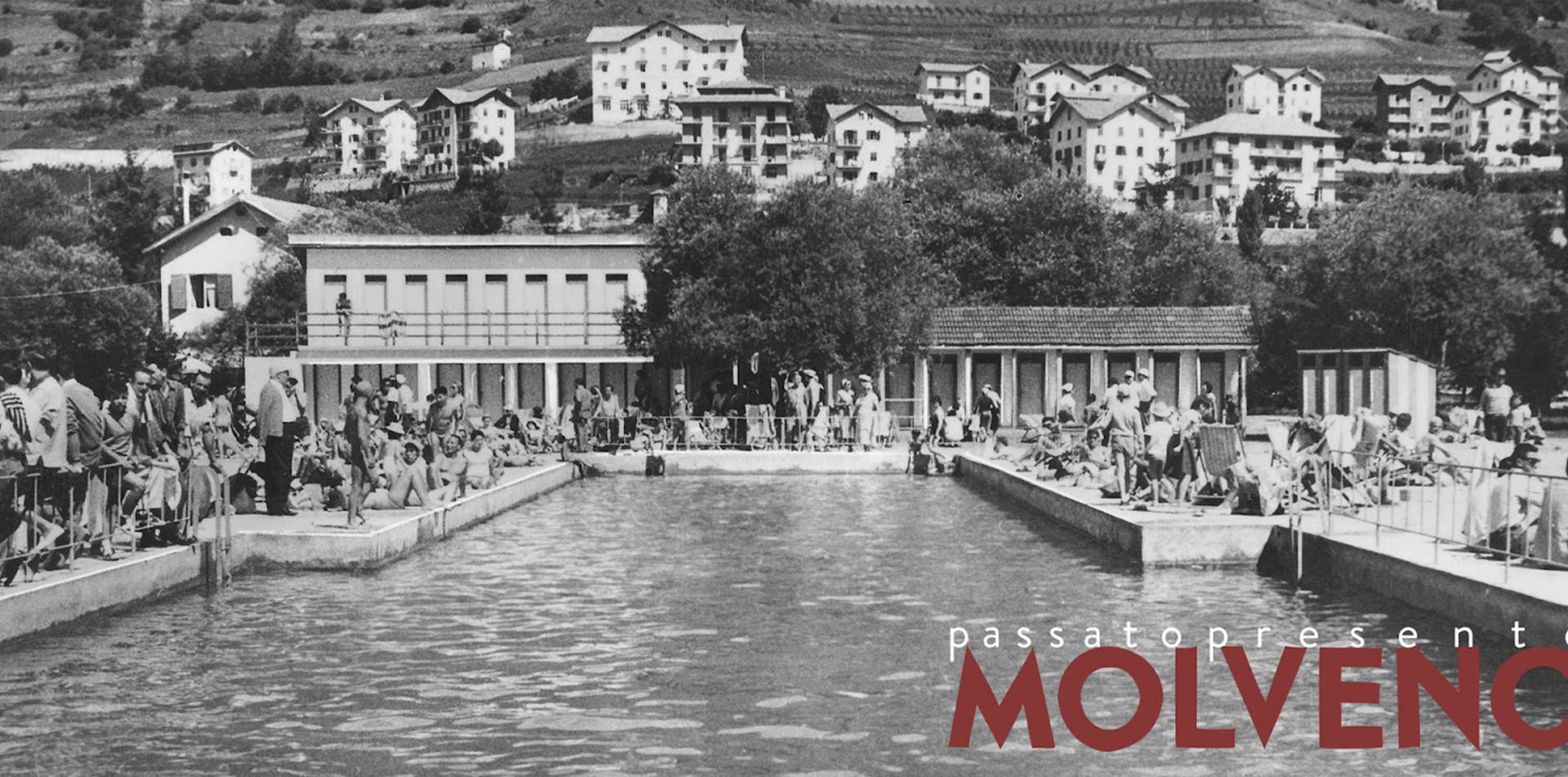
At the beginning of the twentieth century a new phase began for tourism in Molveno. New structures were built that boosted economic development, but a change in mentality also occurred. A population of farmers changed into mountain guides, hoteliers, waiters, cooks and shopkeepers. The presence of two figures capable of anticipating the times was decisive: the passionate mountaineer Osvaldo Orsi and the innovator of tourism and hospitality Attilio Bettega. At the end of the nineteenth century Molveno was the main starting point for mountaineers who wanted to venture towards the Brenta peaks through the Val delle Seghe. Personalities like King Umberto I of Belgium and his son Leopold III with Queen Astrid came in Molveno. Guests arrived from all over Europe: from London, Wien, Prague and Brussels. The Vienna Opera House stayed at the Grand Hotel. Umberto Nobile in 1926, Guglielmo Marconi in 1930, English Prime Minister Chamberlain in 1931 were other illustrious visitors. The cyclist Learco Guerra in 1935. In these years other historic hotels opened and the first bathhouse was built on the banks of Lake Molveno.
TYPICAL WORKS IN MOLVENO:
In the overall economic resources available to the locality of Molveno, the exploitation of forest and timber certainly emerges. Unlike the production of agricultural products, this had a commercial response to the Po-Veneto area. In this context the case of Molveno is to be placed, where, after 1590, the first sawmill was built. It is significant that this sawmill was built by a Venetian, Don Antonio Tajalacqua, who arrived in Molveno as a curate. There were five Molveno sawmills: Sega Tajalacqua, Sega Donina, Sega Massenza, Sega Meneghina and Sega Giandrona. However, the exploitation of forest resources was not the only source of livelihood for the population before the arrival of tourism. A large part of the population was, in fact, employed in other activities, linked to the world of livestock and agriculture, activities that alone were not sufficient to guarantee sustenance. In the Molveno district there were two dairy houses for mountain pasture with the possibility of making on-site cheese production.
HYDROELECTRIC EXPLOITATION OF LAKE MOLVENO:
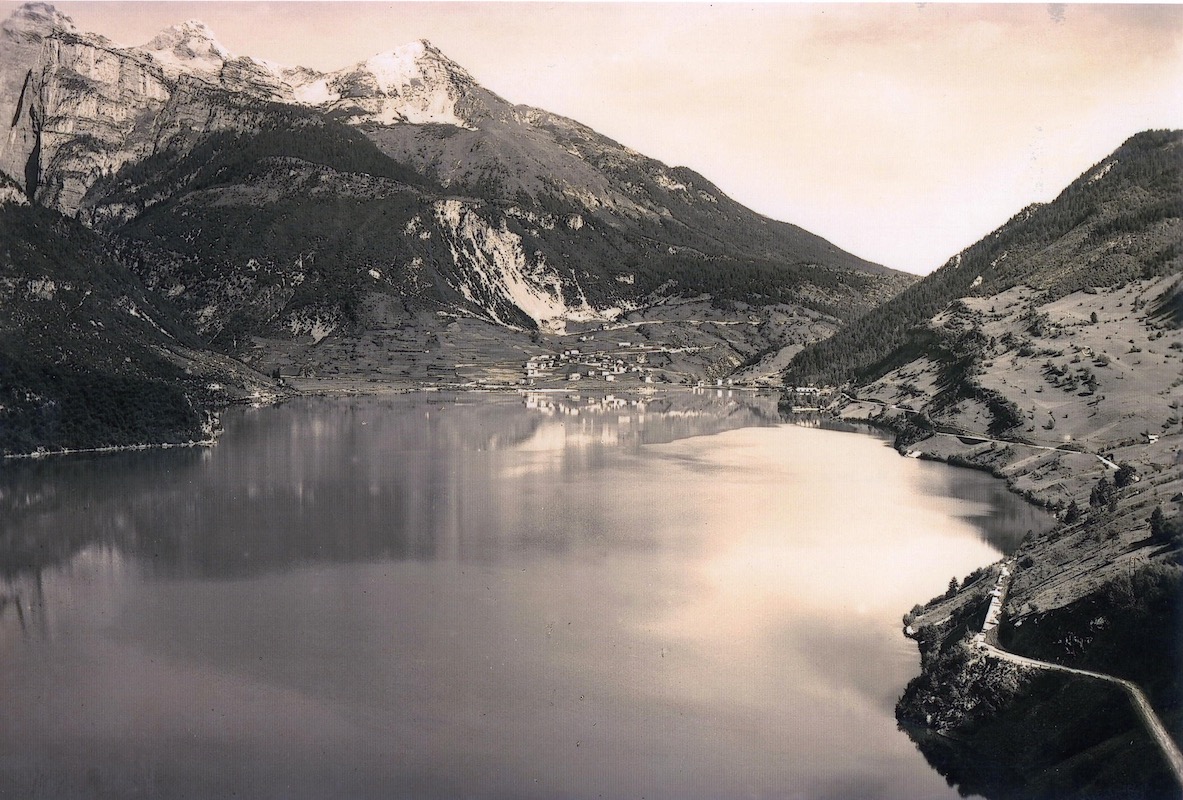
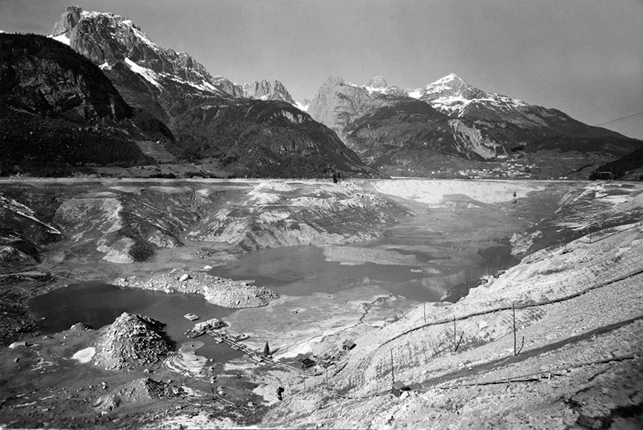
In 1914 the idea of a large-scale exploitation of the Sarca basin was born. Among the numerous projects, the one proposed by the engineer Stolcis, who in 1925 had developed the derivation of the upper course of the Sarca in Lake Molveno, was chosen. Despite the enormity of the work, this design solution immediately proved to be the most effective for achieving the set objectives and also the most advantageous, both from an economic point of view and from that of the full exploitation of the concerned water resources. The works in Molveno lasted more than five years from 1948 to 1953, and more than 8000 workers were working simultaneously, requiring a very high human cost: almost 50 were the deaths related to the construction of the entire water derivation system. At the end of the works, a 25.2 km tunnel had been created, it crossed the Brenta Dolomites and arrived in Lake Molveno. A tunnel of about 5 km was created across the Mount Gazza to bring the water from the Molveno basin to the Santa Massenza power station, and at the end of the tunnel two 85% forced pipes were planned, with a jump of 487 m. The emptying of Lake Molveno had brought to light the remains of a submerged forest which, with the dating of radiocarbon, allowed the birth of the Molveno natural basin to be relocated to around 1000 BC.
“THE LORDS ARE COMING!” MOLVENO AND THE 50’S
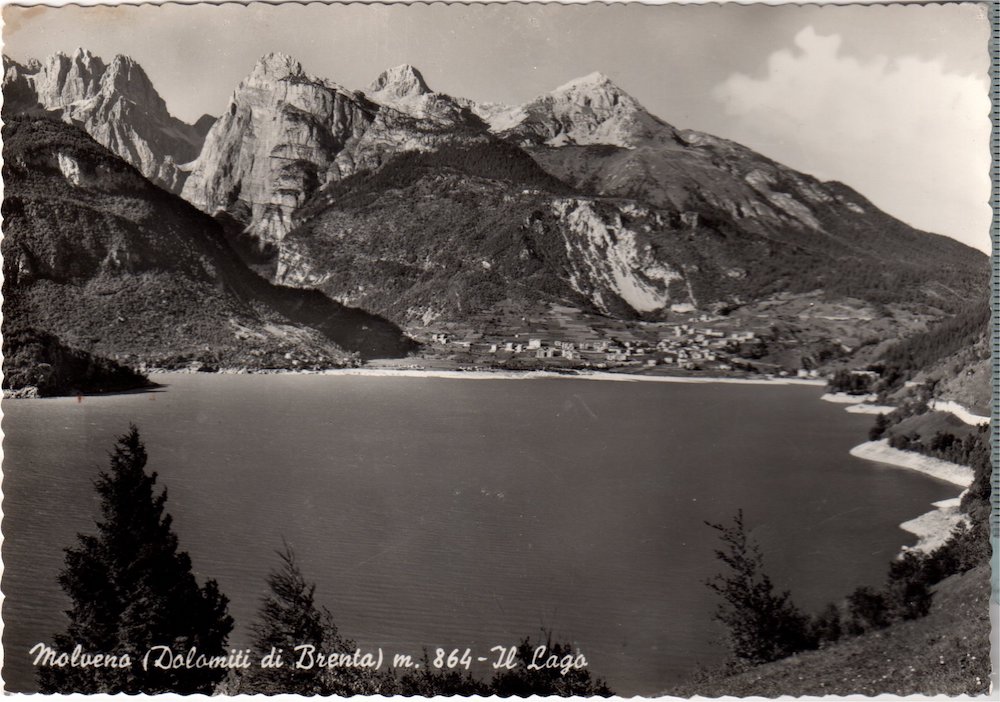
Until the 50s, Molveno maintained a mixed economy: most families lived on agriculture, breeding and timber cutting, but the exploitation of new touris possibilitiest was starting to become more and more important. The hotels built from the 20/30s of the twentieth century first maintained the vegetable garden, the barn and the chicken coop, and with their own production they managed to satisfy part of the needs of the house that became a hotel, offering guests: vegetables, potatoes, eggs, cheese made with their own cows, meat and home-made cold cuts from Molveno. With the start of the Second World War, that tourism development process temporarily came to a halt. The country experienced a period of difficulty and several hotels were used as accommodation for the Italian German troops. Starting in 1950, there was a recovery thanks to the reconstruction started all over Europe. There were some families of Molveno who could offer some rooms to vacationers: they often left their homes during the summer to be able to rent them to foreigners. This model was followed by an increasing number of families, so that tourism became an important economic resource. There were a large number of small and very small family-run hotel businesses which replaced the old farm model. Between the 1950s and 1960s, in Molveno, the face of the locality radically changed: work on transforming the lake began.